


Key takeaways
- Smart lighting control systems enhance convenience by automating lighting based on movement and occupancy.
- These systems facilitate better lighting management across different areas of a building.
- Dimming and scene control allow flexible lighting options for various activities and moods.
- Occupancy-based lighting can optimize energy efficiency by adapting to real-time usage patterns.
- Selecting the right smart lighting control system requires careful consideration of sensor technologies and building needs.
Bright Ideas is a leading multi-brand architectural lighting showroom in Ahmedabad, offering lighting controls and automation solutions for homes, offices, hotels, commercial buildings, and modern architectural projects. A smart lighting control system can make lighting more responsive by allowing users or connected devices to switch, dim, schedule, or control lights according to the requirements of different spaces.
Modern lighting is no longer limited to turning a switch on or off. Motion sensors, occupancy detection, touch panels, wireless switches, dimmers, smart controllers, and building-management integrations can work together to create a more convenient and adaptable lighting environment.
What Is a Smart Lighting Control System?
A smart lighting control system is a combination of hardware and control technology used to manage lighting more intelligently. Depending on the project, this can include sensors, switches, dimmers, scene controllers, wireless controls, smart drivers, and building-management interfaces.
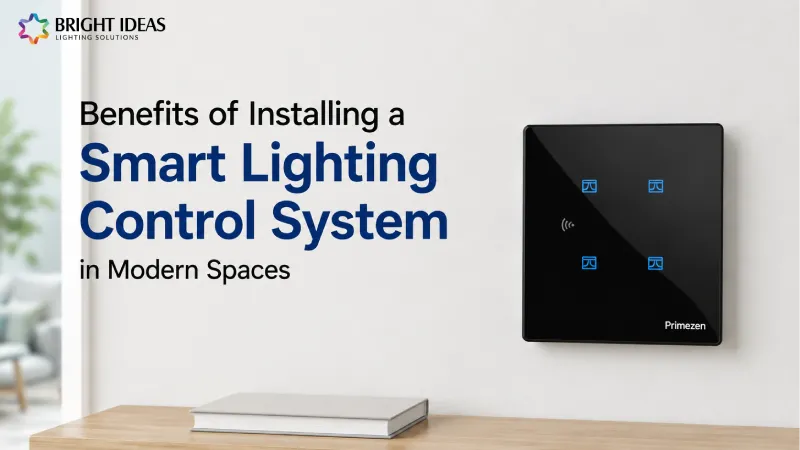
Bright Ideas currently lists five main lighting-control categories: motion sensors, touch panels, wireless switches, light controllers, and smart drivers. Its current brands include Sensinova, Prime Zen, and Infine8.
The actual system depends on the building, lighting fixtures, control requirements, wiring, and the level of automation required.
Key Benefits of Smart Lighting Control
1. More Convenient Lighting
Smart controls can make everyday lighting easier to operate. Instead of manually controlling every fixture, selected lights can respond to movement, occupancy, scenes, schedules, or wireless commands.
For example, motion sensors can be useful in corridors, stairwells, and basements where lights only need to operate when people are moving through the area.
2. Better Lighting Management
A well-planned smart lighting control setup allows different areas of a building to operate according to their individual requirements.
An office can have separate lighting zones for cabins, meeting rooms, and open-plan areas. A hotel can use scene controls for guest rooms. A premium home can use touch panels or app-based controls for different lighting scenes.
3. Dimming and Scene Control
Dimming gives users more control over the amount of light being used. Bright Ideas currently lists TRIAC, 0-10V, DALI DT6, and DALI DT8 control options across applicable lighting-control solutions.
Scene control can also allow multiple lights to respond together. A single command might activate a predefined combination of lighting levels for activities such as relaxation, meetings, presentations, or entertainment.
4. Occupancy-Based Lighting
Motion and occupancy sensors can help lighting respond to how a room is being used. These systems are especially useful where occupancy changes throughout the day.
Bright Ideas distinguishes between motion-based control, where lights respond to movement, and occupancy-based control, where lights remain active while people are present even when they are sitting relatively still.
Choosing between these approaches is important because a sensor should match the behaviour of the space.
Smart Lighting Control for Homes
Residential lighting automation can range from simple wireless switches to more advanced scene-based systems.
In a modern villa or apartment, different rooms can use different control methods. Living rooms may benefit from scene control, bedrooms can use bedside switches, and corridors may use motion detection.
Bright Ideas lists Wi-Fi and Bluetooth-based control options for applicable products, along with wireless switches and touch panels.
This allows homeowners to build a lighting system around how their family actually uses the space rather than applying the same control method everywhere.
Intelligent Lighting Management for Workplaces and Business Environments
Commercial buildings often have larger lighting zones and more varied occupancy patterns. This makes lighting control particularly useful when properly planned.
Typical applications include:
- Office cabins and meeting rooms
- Open-plan work areas
- Corridors and staircases
- Hotels and guest rooms
- Retail and commercial spaces
- Basements and utility areas
- Premium residential developments
For larger projects, DALI, Modbus, and BACnet integration can be considered where building-management systems are part of the project specification. Bright Ideas lists these integration options for applicable enterprise control solutions.
How to Choose the Right Smart Lighting Control
Not every project needs the same type of automation. Before selecting products, consider five practical factors:
- Sensor technology: PIR, microwave, true-presence, daylight, and other technologies serve different applications.
- Detection requirements: A corridor may need movement detection, while an office cabin may benefit from occupancy sensing.
- Dimming protocol: TRIAC, 0-10V, and DALI have different applications and compatibility requirements.
- Power and wiring: Mains-wired, wireless, battery-free kinetic, and low-voltage control options can suit different installation conditions.
- BMS integration: Larger projects may need a planned gateway architecture if the lighting system is being connected to a building-management system.
Planning these points during the design stage can prevent compatibility problems later.
Smart Lighting Control in Ahmedabad
Ahmedabad is home to a wide range of residential, hospitality, commercial, and architectural projects where lighting controls can be incorporated into modern lighting schemes. For local architects, interior designers, contractors, and homeowners, visiting a specialist showroom can make product selection and system planning easier.
Bright Ideas operates from 111, First Floor, The Grand Monarch, Ahmedabad, and provides lighting controls alongside indoor, outdoor, decorative, and architectural lighting categories. The showroom supports homeowners, architects, designers, consultants, and businesses.
Customers can discuss their requirements with the team and compare control options based on the lighting fixtures and intended application.
Choosing a Smart Lighting Control System Dealer
Working with an experienced smart lighting control system dealer can be valuable when a project contains multiple lighting types and control requirements.
The dealer should understand how sensors, switches, dimmers, drivers, controllers, and lighting fixtures interact. This is particularly important for larger projects where control compatibility needs to be considered before wiring and installation.
Bright Ideas follows a specification-focused approach and provides product shortlisting, AutoCAD lighting layouts, BOQ support, on-site survey services within the Ahmedabad metro area, commissioning, zone mapping, and post-installation tuning for applicable projects.
For architects and project teams searching for a reliable smart lighting control system dealer, this combination of products and project support can make system planning more straightforward.
Smart Controls and Energy Management
Lighting controls can contribute to more efficient lighting operation by allowing lights to respond to occupancy, daylight, schedules, or user requirements. The actual reduction in energy use depends on the lighting load, control strategy, occupancy pattern, operating hours, and system configuration.
For commercial and larger architectural projects, controls can also be incorporated into broader building-management strategies. Bright Ideas lists ECBC, GRIHA, and LEED-related project compatibility within its lighting-control offering.
The key is to design the control strategy around how the building is actually used.
Why Choose Us
We focus on making lighting automation practical for real projects rather than treating smart controls as an isolated technology. Bright Ideas offers motion sensors, touch panels, wireless switches, light controllers, and applicable smart-driver solutions alongside a complete architectural lighting catalogue. Our team works with homeowners, architects, interior designers, consultants, dealers, and businesses on product selection, layouts, BOQ support, commissioning, and project coordination. With our Ahmedabad showroom and specification-focused approach, we help customers match the control method, lighting fixtures, and automation requirements before installation.
Conclusion
A smart lighting control system can make modern spaces more convenient, adaptable, and responsive by connecting lighting with sensors, switches, dimming systems, scenes, and other controls. The right solution depends on the type of space, occupancy behaviour, lighting fixtures, wiring, dimming requirements, and the level of automation needed. Homes may benefit from wireless switches and scene control, while offices and commercial buildings may require occupancy sensing, zoning, dimming, and BMS integration. Choosing the system at the planning stage helps improve compatibility and installation coordination. Bright Ideas provides lighting-control products and project support from Ahmedabad for residential, commercial, hospitality, and architectural applications.
Looking for a smart lighting control system for your next project? Contact Bright Ideas at +91 91062 00232 or contact@brightideas.in for product selection and project assistance.
