


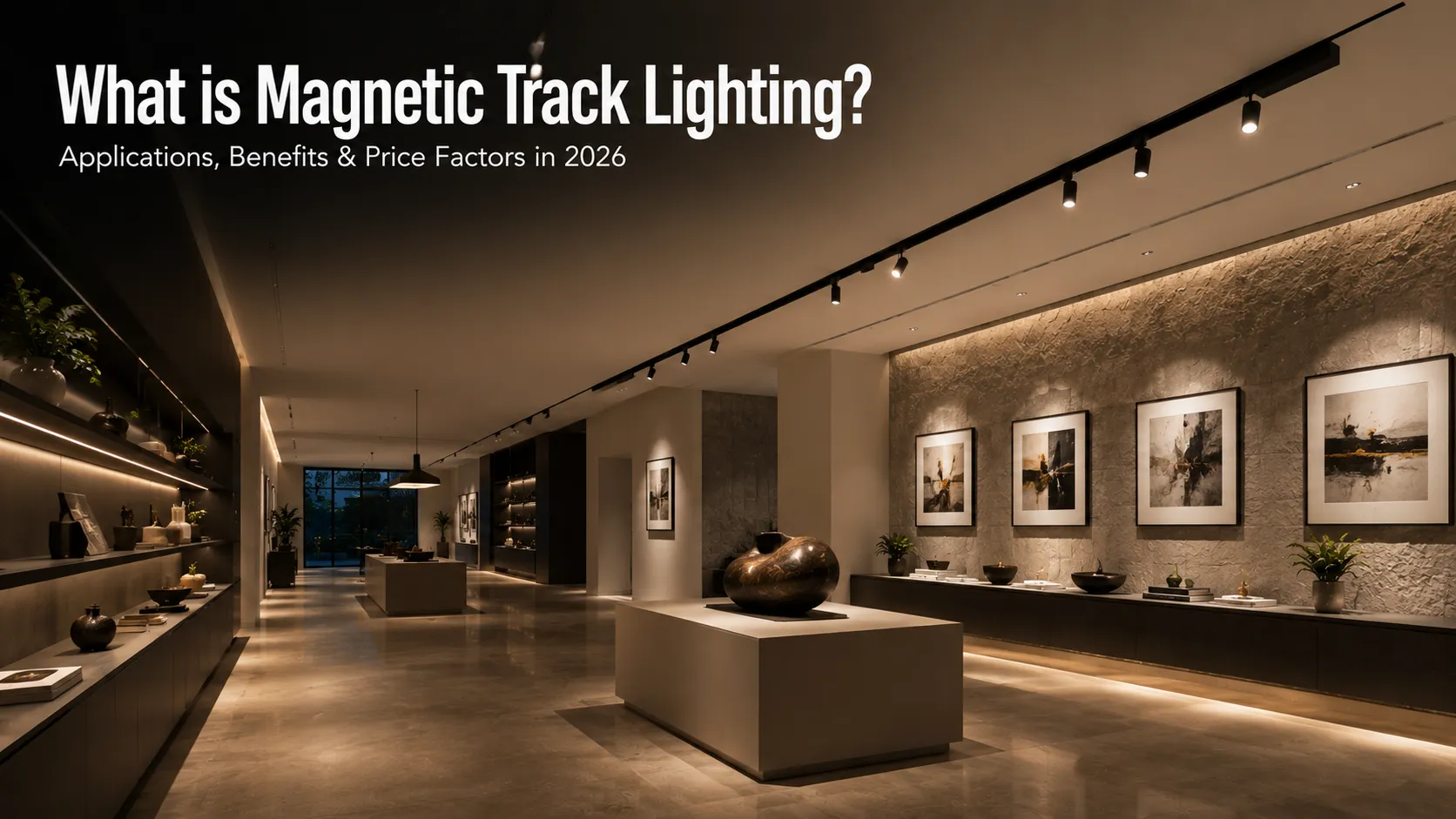
Magnetic track lighting is the most quietly disruptive system in architectural lighting since the LED itself. A single 48V rail in the ceiling lets you place, swap and re-aim spotlights, linear washers and diffusers without rewiring, without re-cutting plaster, without an electrician. For retail, gallery, hospitality and any project where the lighting layout might need to evolve after handover, it's become the default specification. This guide explains how the system actually works, what fixtures you can put on it, where it fits best, and the factors that decide what it costs.
What is magnetic track lighting?
Magnetic track lighting is a low-voltage rail system. A flat extruded aluminium channel — either recessed flush with the ceiling or surface-mounted — carries 48V DC (or 42V DC for 1-10V dimmable variants) along its length. Fixtures don't bolt on or wire in: they have a magnetic clip-lock base that snaps into the rail anywhere along its run. Pop them off, slide them down, swap them for a different beam angle, all without tools or power-down.
The system descends from older 230V three-circuit track (Eutrac, Global) but with three architectural improvements: low voltage means the rail can be slimmer and recessed trimless, the clip-lock interface lets fixtures move post-handover, and the catalogue has expanded from just spotlights to include linear profiles, wall washers, sphere accents, diffuser panels and even tubular pendants — all on the same rail.
How magnetic track lighting works
The rail system
Each Hybec-Pro magnetic track rail is an extruded aluminium channel with twin copper conductors running its length, carrying 48V DC (or 42V on the 1-10V dimmable variant). Rails come as recessed trimless (plaster-in, sits flush with the ceiling plane) in 0.5m, 1m, 1.5m and 2m runs, or as surface-mounted (clips to any flat ceiling) in 1m, 1.5m and 2m runs.
Multiple rails connect via L-connectors, curve connectors, current connectors and track-to-track jointers — so layouts can run straight, around corners, in U-shapes or as floating islands. A 48V DC driver sized 60W, 100W, 150W or 200W feeds each rail run from a junction box hidden in the plenum.
Clip-lock fixtures
Every fixture in the system has a magnetic clip-lock base. Two small magnets and spring contacts engage when the fixture's base touches the rail's open face. The fixture latches in place, gets power immediately, and can be removed by hand. Most spots and linear fixtures rotate and tilt on the base — point the beam, lock the joint, done.
Voltage matters: 48V vs 42V
Most of the catalogue runs on 48V DC — track spots, double and hanging spots, diffuser tracks, linear spots, wall washers, sphere accents, museum lights, circular wall washers. The 42V variant exists for fixtures that need 1-10V analogue dimming — linear spots and washers in the 4W–14W range. Confirm the voltage at order so the rail, driver and fixtures all match — a 42V fixture won't power on a 48V rail, and vice versa.
What you can put on a magnetic track
This is where magnetic track has separated itself from traditional spotlight track. The Hybec-Pro catalogue alone offers 69 SKUs across fixtures and accessories, organised into seven groups:
- Track spots — 2.2W, 8W, 13W, 19W, 22W and 34W round spots with adjustable beam. The workhorse fixture for accent, retail and gallery spotlighting. All On/Off · TRIAC · DALI.
- Double & hanging spots — 2×2W and 2×7W double-head spots, 7W and 18.5W hanging spots that drop below the rail for higher ceilings and chandelier-style pendant clusters.
- Diffuser tracks — 5W, 10W, 12W, 18W diffused linear modules. Used for soft ambient illumination along the rail without the directional spot beam. L-shape variants available.
- Linear spots and wall washers — 3.3W, 4W, 7W, 10W, 14W and 18W linear modules in both spot (concentrated beam) and wall washer (graze) configurations. The linear washer is where magnetic track shines for facade or feature-wall illumination indoors.
- Sphere, tubular and circular — magnetic sphere spots (14W), diffused tubular pendants (20W–30W), circular wall washers and diffuser lights. Decorative-leaning fixtures that double as architectural accent.
- Museum lights — 7W and 10W tightly-controlled museum spots for artwork and curated retail.
- Track accessories — recessed and surface rails, L and curve connectors, current connectors, jointers, drivers in four wattages, suspension kits, end caps and covers.
Where magnetic track lighting fits best
Retail and gallery
The single strongest use case. Retail merchandise rotates seasonally, gallery exhibits change every few months, showroom displays move with collection drops. Traditional fixed spotlights need an electrician to re-aim or re-locate; magnetic track fixtures move in seconds, no power down. Museum spots and adjustable spotlights on the same rail let curators run different beam angles within the same gallery wall.
Hospitality
Hotel lobbies, restaurant interiors, bar lounges and event spaces use magnetic track for zoned scene control — DALI-dimmable spots cluster over banquettes, linear washers graze textured walls, diffuser modules deliver ambient overflow. The ability to re-spec parts of the system (swap a spot for a wash, add fixtures to an under-lit zone) without redoing the ceiling is the closing argument.
Residential
Magnetic track has migrated into premium residential — typically in living rooms with feature walls, gallery corridors, kitchen islands, and double-height entry foyers. The 48V system reads cleaner than 230V track and the recessed trimless rail disappears into a plaster-in ceiling. For families with rotating art collections or kids with changing room layouts, the post-handover flexibility is a real benefit.
Commercial
Cabin and meeting-room lighting for offices, especially where the room layout might change with seating reconfigurations. DALI-dimmable spots for video calls, wall washers for background presence, linear modules for ambient. The same rail run handles all three.
What drives the price of a magnetic track setup
Magnetic track is a system you're buying, not a single fixture. The total cost is decided by four factors that you control.
1. Rail length and type
Recessed trimless rails cost more than surface rails (more material per unit length, plaster-in finishing). Total rail length scales linearly with the catalogue spec — a 12m run costs 24× a 0.5m starter.
2. Fixture count and mix
Basic track spots are the entry price point. Linear washers, museum spots, diffuser tubulars and sphere accents step up. A retail wall with 12 mixed fixtures (4 spots, 4 wall washers, 4 diffuser modules) will cost differently than 12 identical spots.
3. Dimming protocol
Non-dimmable fixtures are the lowest cost. TRIAC dimming adds modestly. DALI DT6 / DT8 adds more — DALI fixtures and drivers carry the chipset that lets them speak to a BMS or scene controller. For commercial DALI projects the system cost includes the DALI controller as well.
4. Driver sizing
Each rail run needs a 48V driver sized to the total connected fixture load. Drivers come in 60W, 100W, 150W and 200W variants. A retail floor with eight 100W rail runs needs eight drivers, not one — that's a system-level cost the quotation has to account for from day one.
We don't publish pricing on the public site — the quotation for any specific project is sized to the rail layout, fixture mix and driver count for that space. Request a consultation for a detailed quotation tailored to your project.
Magnetic track vs traditional 230V track
Older 230V three-circuit track systems (Eutrac, Global) are still found in commercial retail and showroom retrofits — they work, they're proven, and they're widely stocked. Where magnetic track wins is on architectural integration (trimless recessed rail vs visible 230V rail), fixture variety (linear washers, diffuser modules, sphere accents — not just spotlights), and the post-handover flexibility of the clip-lock interface. Where 230V track still wins is on cost per watt for high-output halogen-replacement spots and on availability of legacy fixtures in stock. For new architectural work in 2026, magnetic track is the default specification.
How to plan magnetic track for your project
Planning magnetic track for your space means four decisions, in order:
- Layout. Mark the rail runs on your ceiling plan. Decide recessed trimless or surface mounted. Note the corner connectors and jointers needed.
- Fixture mix. Spot count for accent. Linear count for ambient or washing. Wall washer count for feature walls. Diffuser count for background lighting. Lock the mix before sizing the drivers.
- Dimming type. Non-dimmable for utility runs, TRIAC for retrofit-style homes, DALI for any setup with scene control or building-management integration. One dimming type per rail run — don't mix.
- Driver count and sizing. The total wattage per rail run decides the driver size. Plan one driver per run; for very long rails, split into segments with separate drivers and connectors.
At Bright Ideas we curate Hybec-Pro magnetic track alongside the rest of our multi-brand catalogue — recessed downlights, COB spots, sensors and smart controls — and prepare a tailored quotation sized to your specific layout. If you're planning magnetic track for an upcoming project, request a consultation and our team will send the product list, AutoCAD layout drawing and detailed quotation within seven working days.
