


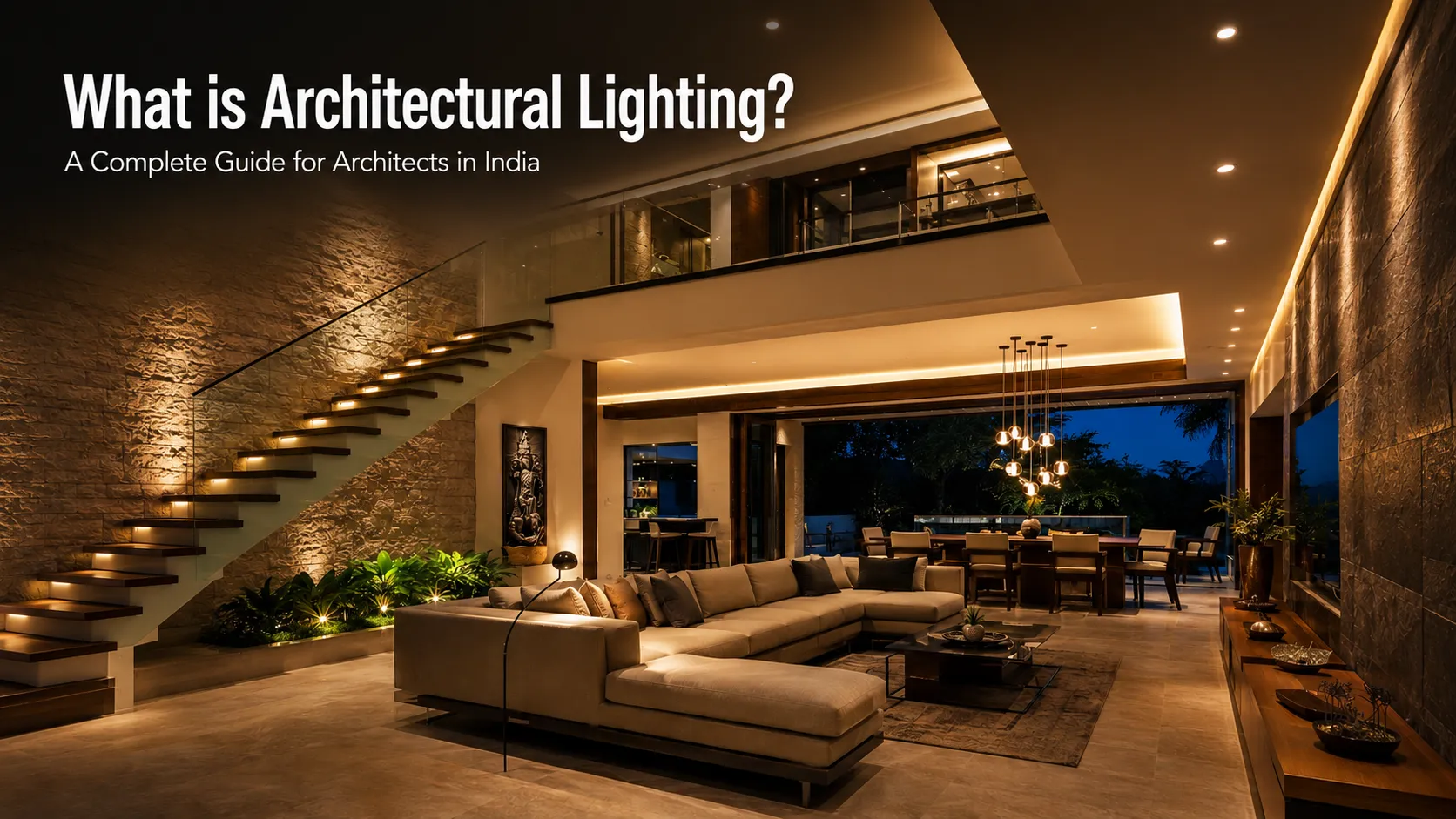
Every project — a home, an office, a hotel, a shop — eventually arrives at the same question: who is going to light this space, and when do we bring them in? The homeowners, architects and designers who get the answer right early end up with rooms that look beautifully lit. The ones who get it wrong end up with surface-mounted retrofits, mismatched colour temperatures and expensive rework. This guide is the foundation primer for getting it right — what architectural lighting actually is, the three layers it works in, the five things that decide every fixture, and the mistakes that cost the most.
The three layers — ambient, task and accent
Architectural lighting works in three layers, each doing a different job. A well-thought-out plan will have all three present at every point in the building, with the architect or lighting expert controlling the balance between them by zone, time of day and scene.
Ambient — the base layer
Ambient is the general illumination that makes a space usable. In residential and hospitality work it's typically delivered by recessed downlights on a 1.2m–1.5m grid, 60° to 90° beam, 3000K or 4000K depending on the room use. In commercial and office work it's usually UGR-controlled linear profile or panel fixtures targeting 300–500 lux at the working plane. Ambient is the layer that decides whether the room feels lit or under-lit; it's the layer most often shortchanged when people count downlights instead of calculating lux.
Task — focused work light
Task lighting is where the work happens. Under-cabinet strip in kitchens. Pendant clusters over dining tables and kitchen islands. Vanity lights flanking bathroom mirrors. Desk lamps in workspaces. Adjustable spots on retail counters. The rule of thumb is that task light should be at least 2× the ambient level on the work surface, with the colour temperature matched (no warm pendants over cool ambient — the eye reads the mismatch as a quality problem even if the architect can't name it).
Accent — sculpting the architecture
Accent is where architectural lighting earns its name. COB spots on artwork. Adjustable magnetic-track lights on retail merchandise. Linear profile in coves reading the ceiling plane. LED strip behind shelving washing the back wall. Step lights grazing the staircase riser. Wall washers picking out a textured stone facade. The accent layer is what tells the viewer what the architect wanted them to look at. Three-to-five times the ambient level on the accented surface is the typical target ratio.
The five things every buyer should know
Picking a fixture by wattage alone is the most common mistake in architectural lighting. A 10W downlight at 2700K with 90 CRI and a 60° beam is a completely different fixture from a 10W downlight at 6500K with 80 CRI and a 24° beam. Choosing architectural lighting is five things, not one.
1. CRI — Colour Rendering Index
CRI measures how accurately a light source renders colour compared to natural daylight, on a 0–100 scale. CRI 80 is the LED minimum and shouldn't appear in architectural work. CRI 90+ is your baseline — choose it for homes, hotels and offices. CRI 95+ for galleries, retail showrooms, curated restaurants and any space where the perceived quality of finishes, fabrics or skin tones matters. The CRI is fixed at the LED; you cannot dim or filter your way to better colour rendering after you've bought the fixture.
2. CCT — Correlated Colour Temperature
CCT is the warmth or coolness of the light, measured in Kelvin. 2700K (warm white) for hospitality lobbies, premium residential, restaurants and bedrooms. 3000K for general residential living spaces. 4000K (neutral) for offices, retail and modern interiors. 5000K to 6500K (cool) for kitchens, utility and clinical environments. CCT-tunable fixtures span 2700K to 6500K on a single SKU, switched at install or controlled continuously via DALI DT8 — useful for spaces with shifting use (a hotel meeting room that's bright and neutral by day, warm and dim by evening).
3. Beam angle
Beam angle is how the light spreads from the fixture. Narrow (24° or less) for accent and artwork. Mid (38°–60°) for general residential ambient. Wide (90°–120°) for ambient and ceiling washing. Cross-checking beam angle against mounting height is the most common miss — a 24° spot at 4m mounting height delivers a 1.5m diameter pool of light, not flood. People planning lighting for double-height spaces routinely under-specify beam angle and end up with hotspots instead of even illumination.
4. IP rating
Ingress Protection rating describes how protected the fixture is from dust and water. The first digit is dust (0 to 6); the second is water (0 to 8). IP20 is dry indoor and the architectural-lighting default. IP44 for damp areas — bathrooms outside the shower zone, kitchens above hobs. IP65 for outdoor walls, pathways and shower-zone fixtures even indoors. IP67 for submerged or sprinkler-zone outdoor use. IP68 for full water immersion — swimming pools, fountains, reflecting ponds. Mis-rating an outdoor or wet-zone fixture is the most common cause of architectural-lighting failures inside the warranty window.
5. Dimming protocol
Dimming protocol is the language the fixture speaks back to the control panel. TRIAC for residential retrofit, working with any standard wall dimmer. 0-10V for simple commercial dimming over an analogue control wire. DALI DT6 for single-channel BMS-integrated commercial work. DALI DT8 for tunable-white systems where CCT changes with scene. Bluetooth or WiFi for smart-home retrofits where wired control isn't an option. Pick the protocol per zone, lock it before choosing drivers, and don't mix protocols inside a single zone — that is what causes commissioning to fail at handover.
Architectural lighting vs decorative vs general — how they differ
Most architectural projects use all three layers; the categories overlap. But the distinctions matter at specification stage, because each is sourced, priced and detailed differently.
| Architectural | Decorative | General | |
|---|---|---|---|
| Primary purpose | Integration with the building's design | Identity — fixture as object | Utility illumination |
| Visibility of fixture | Often concealed or recessed | Visible and intentional | Functional, not styled |
| Typical CRI | 90+ standard, 95+ for premium | 90+ | 80+ |
| Documentation | IES files, datasheets, photometric data | Finish samples, drop heights | Wattage and lumen rating only |
| When specified | Schematic design | Interior finishing | Execution / retrofit |
| Examples | Recessed downlight · COB spot · Linear profile · Magnetic track | Chandelier · Pendant · Wall sconce · Table lamp | Surface-mount LED · CFL · Tube light |
The fixture vocabulary worth knowing
Choosing architectural lighting means knowing the catalogue. The fixtures below cover roughly 90% of indoor architectural work in India — each has its own typical use and key things to look for.
- Recessed downlights — the workhorse of indoor architectural lighting. Round or square, plaster-in trimless or framed, available in shallow profiles (sub-50mm depth) for tight plenums. Specify wattage, beam angle, CCT, CRI and dimming protocol together as a five-field block.
- COB (Chip-on-Board) lights — high-output single-chip LEDs delivering even, dot-free illumination from a small aperture. Used for accent, gallery, retail and any application where a clean, concentrated beam matters. The Bright Ideas catalogue includes 47 Aronix COB series.
- Magnetic track lights — 48V or 42V low-voltage rails (recessed-trimless or surface-mounted) that accept clip-lock fixtures: spots, linear profiles, diffuser modules, wall washers — all moveable along the rail without rewiring. Ideal for retail, gallery, museum, hospitality and any project where the lighting layout might need to evolve after handover.
- Linear profile lights — extruded aluminium channels with integrated LED strip, available in recessed (plaster-in), surface, suspended and bevelled configurations. Used for coves, perimeter lighting, ceiling reveals, niche illumination and architectural detailing.
- Track lights — surface or recessed metal rails for spotlights. Older 230V three-circuit systems (Eutrac, Global) are being replaced by 48V magnetic track in most new architectural specification work.
- Outdoor / IP-rated fixtures — bollards, wall lights, garden spikes, step lights, underwater fixtures, facade IP profile, floodlights. This category is defined by IP rating, body material and environmental durability (marine-grade powder coat, stainless-steel bases for coastal sites).
The most common lighting mistakes
Three mistakes cost people more than all the rest combined.
1. Bringing lighting in too late
The single most expensive mistake is bringing a lighting expert in once construction has started. By the time the interiors are finished, the wiring has decided itself — ceiling cutouts are wrong for the chosen fixtures, the conduit isn't where the lighting plan wants it, and the dimming has been wired however the electrician thought was easiest. The right stage to bring lighting in is design — when ceiling layouts, wall finishes and wiring can still flex around the lighting plan.
2. Choosing by wattage alone
Wattage tells you the energy cost of the fixture. It tells you almost nothing about the light it produces. Two fixtures at the same wattage can have completely different beam angles, colour temperatures and colour accuracy. Real architectural lighting selection is the full five-field block — wattage, colour temperature, colour accuracy, beam angle and weatherproof rating — plus dimming. Anything less is closer to general lighting than architectural.
3. Mixing dimming types in the same zone
A lighting scene that mixes TRIAC fixtures with DALI fixtures will dim at different speeds, drift in colour temperature, and fail to respond to scene changes. The moment two fixtures in a zone need to dim together, they need to share the same dimming type. Picking the dimming type for each zone before choosing drivers is what makes the install go smoothly. Skipping that step is what causes commissioning to go badly.
When to bring in a multi-brand lighting showroom
A specialist lighting showroom brings three things to your project: a deep catalogue across multiple brands, expert recommendations matched to each room, and full project support — from layout drawings and detailed quotation to on-site survey, delivery and installation. At Bright Ideas Lighting we curate seven brand partners — Hybec, Aronix, Sensinova, IRO, Prime Zen, SR LED and Infine8 — across indoor, outdoor, decorative and smart controls. The goal isn't to sell more fixtures; it's to make sure the right ones end up matched to your space.
If you're planning lighting for a home, office, hotel or shop, the fastest way to see the catalogue is to request a project consultation — our team comes back with a curated multi-brand product list, an AutoCAD layout drawing and a detailed quotation within seven working days. We work directly with homeowners, architects, interior designers and business owners across India.
