


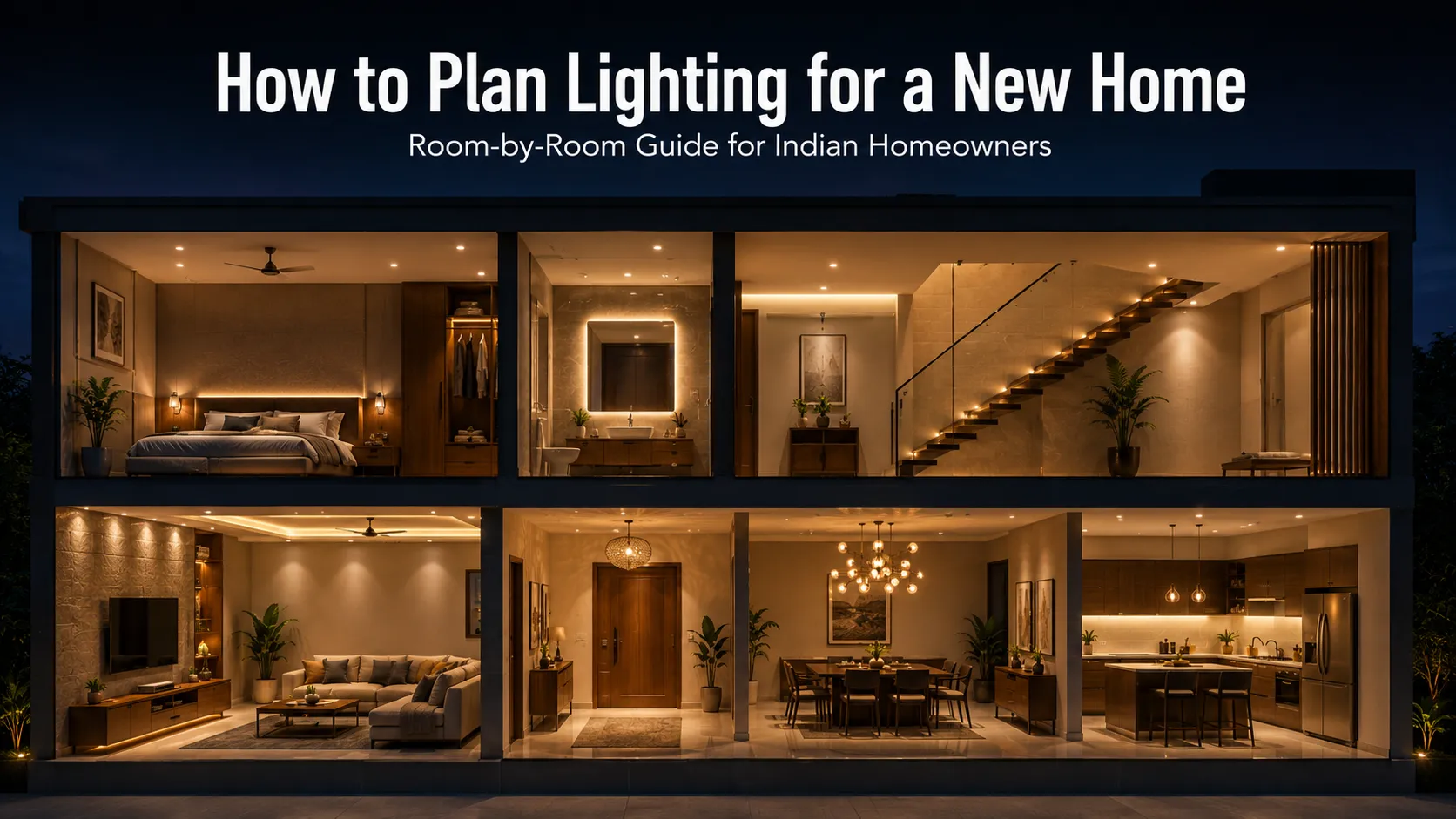
The lighting in a home decides whether it feels lived-in or showroom-stiff, warm or clinical, considered or accidental. And yet home lighting is the layer most often handed off to the electrician on site — counted in downlights and decided by wattage. This guide is the homeowner's and designer's playbook for planning a home's lighting properly. We'll cover when to start, the three-layer principle that runs through every room, and then walk you through every room of a typical Indian home — entrance to balcony — with practical, room-by-room recommendations.
When to plan: start at the design stage
The single most expensive lighting mistake in Indian residential projects is bringing lighting in at the electrical-execution stage. By then, the electrician has already routed the conduit based on rough lighting positions on the architect's plan, and the fixtures have been decided by whoever runs the local lighting shop the electrician knows. Cutouts are wrong for the chosen downlights, the dimming protocol is whatever the wall switch is, and the BOQ is whatever the electrician bought wholesale.
The right sequence is the reverse:
- Floor plan finalised — room layouts locked, ceiling heights known, furniture positions roughly placed.
- Reflected ceiling plan (RCP) drafted — the architect's drawing of what the ceiling looks like from below, with cove positions, false ceiling depths, AC vent locations and structural beams marked.
- Lighting plan layered on top — downlight positions, COB accent points, magnetic track runs, linear cove paths, decorative pendant drops.
- BOQ locked — fixture SKUs, quantities, dimming protocols, driver count. Hand over to the electrical contractor for conduit routing.
Get the order right and the electrician's conduit follows the lighting plan, not the other way around. This is the moment a multi-brand lighting partner adds the most value — preparing the BOQ before conduit goes in, so the spec drives the execution.
The three layers — applied to the home
Every room in the home should have three layers of light. The balance shifts by room and time of day, but the three layers are always present.
Ambient — the base illumination
Ambient is the general light that makes the room usable. In residential work it's usually delivered by recessed downlights on a 1.2m-1.5m grid (9W to 15W per fixture), CCT chosen for the room use (2700K-3000K warm for living and bedrooms, 4000K neutral for kitchen and study), 60° to 90° beam angle for even spread. The target lux is 150-300 lux at chair height for living areas, 100-200 for bedrooms, 300-500 for kitchens. Ambient should be dimmable wherever possible.
Task — focused work light
Task light is where the work happens. Under-cabinet LED strip in kitchens. Vanity lights flanking bathroom mirrors. Desk lamps and pendant clusters over dining tables. The rule of thumb: task light should be at least 2× the ambient level on the work surface, with the colour temperature matched to the ambient layer (warm pendants over warm ambient — no temperature jumps inside the same scene).
Accent — sculpting the room
Accent draws the eye. COB spots on a feature wall. Adjustable magnetic track over a gallery hanging. Linear cove lighting reading the ceiling plane. LED strip behind shelving washing the back wall. Accent is the layer that gives the home identity, and the layer most often missed in standard residential lighting. Three to five times the ambient level on the accented surface is the target ratio.
Entrance & foyer
The first room a guest sees, and the room that decides whether the house feels warm or institutional from the doorstep. The entrance needs:
- Ambient: 2-3 warm-white (2700K-3000K) downlights or a single decorative pendant. CRI 90+ to flatter skin tones and the entryway finishes (often stone, wood or textured plaster).
- Task: a key drop / console light over the entry table — usually a small pendant or a pair of wall sconces flanking a mirror.
- Accent: if there's a feature wall, niche or artwork, one or two adjustable COB spots (24°-38° beam) to wash it.
- Dimming: TRIAC-dimmable so the entrance can go bright for arrivals, low for ambient evening welcome.
Living room
The most layered room in the house. The living room hosts daytime reading, family gatherings, movie evenings, hosted dinners, festival nights — each scene wants a different balance of light.
- Ambient: recessed downlights on a 1.2m-1.5m grid (9W or 12W, 3000K, 90+ CRI, 90° beam). A 12'×18' living room needs roughly 8-10 downlights for proper coverage.
- Task: floor and table lamps adjacent to seating for reading. Pendant cluster over the coffee table for ambient draw without harsh overhead.
- Accent: COB spots or magnetic track on the TV wall or art wall. Linear cove around the ceiling perimeter for indirect "scene" lighting. LED strip behind floating shelves or the TV unit.
- Decorative: a statement pendant or chandelier as the focal piece. Wall sconces flanking the entertainment unit for warmth.
- Dimming: three independent dimming zones — downlights, accent, decorative. Living-room scene control is where DALI or Bluetooth pays back.
Dining room
The dining room runs warm. Decorative dominates; architectural supports.
- Decorative (primary): a statement pendant or chandelier centered over the dining table. Drop height is critical — 28"-32" above the table surface so it hangs in the diners' field without blocking the line of sight across the table.
- Ambient: 4-6 warm-white (2700K) downlights around the table perimeter, dimmable.
- Accent: COB spots on the sideboard or buffet wall.
- Dimming: all dimmable. The dining room is one of the highest dimming-payoff rooms in the house — daylight at lunch, candlelight at dinner.
Kitchen
The kitchen is the highest task-load room in the house. Lighting it well is about getting bright, neutral, glare-free light onto countertops without hot spots.
- Ambient: recessed downlights on a 1m grid (12W or 15W, 4000K neutral, 90+ CRI, 90° beam). Target 500 lux at counter height.
- Task: under-cabinet LED strip running the full length of the counter — this is the highest-value lighting upgrade in a kitchen. Plus a pendant or downlight directly over the hob and prep station.
- Accent: over the island if there is one — a row of 2-3 pendants or a magnetic track with adjustable spots for prep-area focus.
- Dimming: downlights can be TRIAC-dimmable; under-cabinet strip often stays non-dim for daily utility but consider DALI for scene-controlled kitchens.
Bedrooms
Bedrooms run warm and dim. The single biggest lighting mistake in residential master bedrooms is treating them like living rooms — too much downlight, no scene control.
- Ambient: 2-4 warm-white (2700K-3000K) downlights, dimmable. Avoid placing them directly over the bed — go for perimeter positions so the light reads the room without spotlighting the sleeper.
- Task: bedside table lamps or wall-mounted reading sconces, individually switched for each side of the bed. Bath/dressing area task light separate.
- Accent: a single COB spot or wall washer on a feature wall behind the bed. Linear cove for indirect ambient if the ceiling supports it.
- Dimming: mandatory. Bedrooms must dim. A 5-step dimmer or smooth TRIAC dimmer on every fixture in the room is the minimum spec.
Bathrooms
Bathrooms have safety-critical lighting decisions — IP rating, vanity placement, warm vs cool — that compound over time.
- Ambient: 2-3 downlights (3000K-4000K, 90+ CRI, IP44-IP54 rated). Centered over the user zone, not the shower.
- Task (vanity): the most important fixture in the bathroom. Flanking sconces on both sides of the mirror at face height (about 5'6"-5'9" from floor) deliver shadow-free face lighting. A single downlight directly above the mirror is the wrong specification — it casts shadows under the eyes and chin.
- Shower / wet zone: IP65-rated recessed downlight if the shower head is in-zone. IP54 if it's just a damp area.
- Accent: if there's a feature wall behind a tub or a niche, one small COB spot or strip.
- Dimming: on the ambient layer for evening unwind. Vanity task light can stay full-bright.
Study / home office
The work-from-home boom made study lighting a primary spec, not an afterthought.
- Ambient: 4000K neutral downlights, 90+ CRI, 60° beam, on a 1.2m grid. UGR < 19 if you want video-call-friendly glare control.
- Task: a dedicated desk lamp with adjustable arm and dimmable head. Daylight-temperature (5000K) reading task adds focus when needed.
- Accent: a wall washer on the bookshelf or feature wall behind the desk — improves video-call backgrounds significantly.
- Dimming: on ambient. Task stays at full bright.
Staircase
Staircases need light that reads the treads clearly without dazzling the descender.
- Tread illumination: linear LED step lights recessed into the staircase wall at every 2-3 treads. Or strip lighting under the tread nose if the staircase has open risers.
- Ambient overhead: a single pendant in the staircase volume if it's a double-height void, or wall-mounted sconces along the run for single-storey stairs.
- Accent: a wall washer or spot on a feature wall in the stairwell.
- Sensor option: motion-activated step lights for the mid-of-night descent — Sensinova wall-mount sensors paired with low-output warm-white step lights.
Outdoor — entrance, balcony, garden
Outdoor residential lighting carries IP rating constraints and the architectural responsibility to extend the home's identity past the threshold.
- Entrance approach: wall-mounted bollards or recessed step lights along the path. IP65 minimum.
- Facade: graze-uplighting the entry wall with IP-profile linear, or feature-spotlighting with adjustable IP65 outdoor spots.
- Garden / landscape: garden spike lights for accent on trees and sculptural plants. Underwater lights for water features.
- Balcony / verandah: warm-white IP44 wall lights or recessed downlights in the overhang. Dimmable so the balcony can go from utility (food service, planters) to ambient evening.
The full Hybec outdoor catalogue covers all of this across 16 sub-categories from IP44 sheltered fixtures to IP68 underwater.
Putting it all together with a lighting team
For a typical 3-4 BHK villa or apartment, a well-thought-out home lighting plan runs to 40-80 individual fixtures across ambient downlights, accent COB spots, kitchen task, bathroom vanity, bedroom dimmers, decorative pendants and chandeliers, outdoor weatherproof fixtures and scene controls. Sized and priced, that's a real lighting plan — not something that gets decided by which downlight the electrician picks up at the wholesale shop.
At Bright Ideas we work with homeowners directly and through architects to prepare home lighting plans across our seven brand partners — Hybec for recessed and outdoor, Aronix for COB accent, Sensinova for sensors, Prime Zen for decorative, and the rest. If you're building or renovating a home, request a consultation and our team will send a curated multi-brand product list, an AutoCAD layout drawing and a detailed quotation — sized to your floor plan, within seven working days.
