


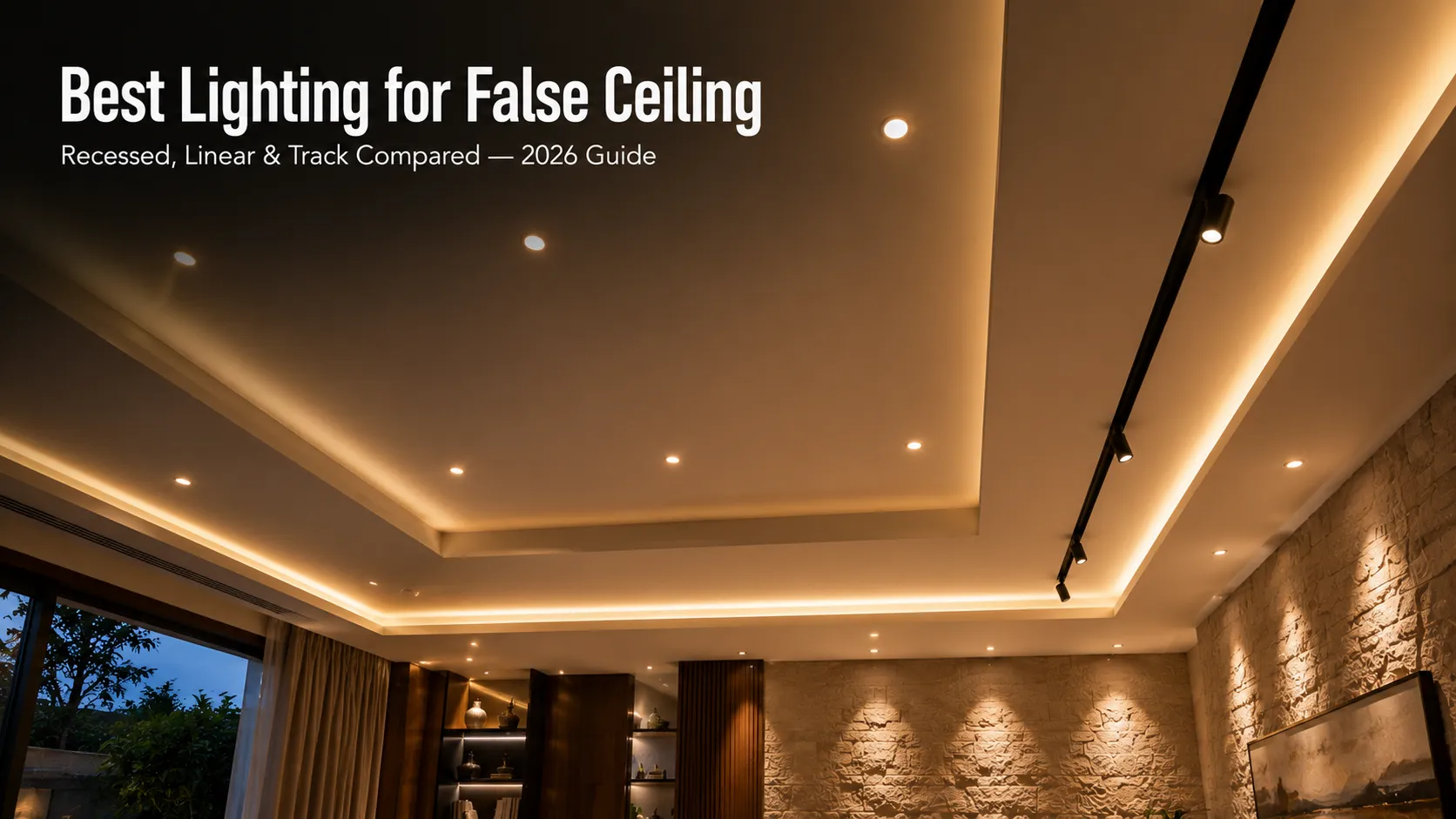
The false ceiling is the most lighting-decisive surface in any Indian interior — it carries the ambient, hides the conduit, frames the coves, and decides how the whole room reads from the ceiling plane down. The fixtures that sit inside it deserve more thought than they typically get. This guide compares the three primary lighting types for false ceilings — recessed downlights, linear profile (cove) and magnetic track — across what each one does, where it fits, and how well-resolved schemes combine all three.
What false ceilings demand from lighting
Before picking fixtures, three constraints decide what's even possible.
Plenum depth
The space between the false ceiling and the structural slab above. Most Indian residential false ceilings have 100-150mm of plenum, which fits anything. Apartment false ceilings often have 60-80mm — tight for standard fixtures but workable. Tighter than 45mm means you're in low-profile territory only. Verify plenum depth before spec.
Conduit routing
The electrical conduit feeds every fixture. The earlier the lighting plan goes in, the cleaner the routing — and conversely, lighting added at execution stage often has to fight the existing conduit layout. A reflected ceiling plan with fixture positions locked before the electrician arrives is the prerequisite for clean false-ceiling lighting.
Weight and access
Gypsum false ceilings handle fixture weight up to about 1kg per square foot per cutout — most architectural LED fixtures sit well within that. Heavier pendants and chandeliers need separate suspension to the structural slab above. Service access for driver replacement should also be planned — drivers sit in the plenum and need to be reachable.
Type 1: Recessed downlights
The workhorse fixture for any false ceiling. Recessed downlights deliver the ambient illumination layer at the lowest cost per square foot of any architectural lighting fixture. They're available in round and square apertures, plaster-in trimless or framed, and across wattage and beam-angle ranges that cover everything from accent (24°) to wide ambient (120°).
When to specify recessed downlights
- Anywhere you need general ambient illumination at a known lux target.
- Standard plenum depths of 50-80mm (use low-profile variants for tighter plenums).
- Living rooms, bedrooms, kitchens, corridors, bathrooms — the workhorse rooms.
- When budget per fixture matters — downlights are the most cost-effective per square foot.
What to specify
- Wattage: 9W to 15W for residential. 18W to 30W for commercial.
- Beam angle: 60° to 90° for ambient. 24° to 38° for accent spots on art or feature walls.
- CCT: 2700K-3000K for living/bedroom. 4000K for kitchen/study. CCT-tunable for rooms with shifting scenes.
- CRI: 90+ standard. 95+ for galleries and art-display walls.
- Anti-glare: deep-recess or anti-glare variants for spaces with sustained eye-level views. UGR < 19 for offices.
- Dimming: TRIAC-dimmable for residential. DALI for scene-controlled.
Type 2: Linear profile (cove lighting)
Linear profile is an extruded aluminium channel with integrated LED strip and a diffuser cap. It sits in a cove (a recessed ledge in the false ceiling) and throws light upward against the ceiling plane, creating indirect ambient illumination with no visible source. The light reads as the ceiling glowing — atmospheric, soft, considered.
When to specify linear cove
- For ambient atmosphere on living rooms, master bedrooms, hospitality interiors.
- To accentuate a ceiling-plane feature — a curved cove, a stepped ceiling, a geometric reveal.
- To hide the light source entirely — the source isn't visible from below, only the lit ceiling.
- For scene control: dimmable cove lighting transforms how a room reads at different times of day.
What to specify
- Profile depth: 40-60mm channel depth. Plus 80-150mm of upward-throw space above the cove for even ceiling wash.
- Output: 8W to 14W per running metre depending on ceiling height and desired atmosphere.
- CCT: 2700K-3000K for atmospheric warm. 4000K for cleaner modern. Tunable for flex.
- CRI: 90+ minimum.
- Driver: 12V or 24V constant-voltage drivers sized to the total run length. Plan one driver per cove circuit.
- Dimming: TRIAC-dimmable or DALI for scene integration.
Bare LED strip in a cove is the cheaper alternative — but skip it on architectural work. Bare strip lacks heat sinking, the LED dots are visible up close, and the cove edge looks unfinished. Architectural linear profile costs more but lasts longer and reads more considered.
Type 3: Magnetic track
Magnetic track lighting is the most flexible fixture system available for a false ceiling. A 48V (or 42V) low-voltage rail sits in the ceiling — recessed trimless or surface — and any number of clip-lock fixtures (spots, linear, washers, diffuser modules, museum lights) snap onto it anywhere along its length. The killer feature is post-handover flexibility: swap fixtures, re-aim spots, add a wall washer, move things around to follow how the room actually gets used. No rewiring needed.
When to specify magnetic track
- For accent lighting that needs to evolve — gallery walls, art collections, retail merchandise, hospitality scenes.
- For combined ambient-and-accent in a single ceiling plane — use a mix of diffuser modules (ambient) and spots/washers (accent) on the same rail.
- For premium residential with feature walls, kitchen islands, double-height voids — the post-handover flexibility is a real benefit.
- For commercial spaces with evolving layouts — cabins, meeting rooms, showrooms.
What to specify
- Rail type: recessed trimless (12-15mm visible channel) or surface-mounted. Decide at ceiling-design stage.
- Rail length: 0.5m to 2m runs, connected with L-connectors, curve connectors and jointers.
- Voltage: 48V for most fixtures. 42V for 1-10V dimmable variants.
- Fixture mix: spots for accent, linear washers for graze, diffuser modules for ambient. Mix and match.
- Driver: 60W to 200W per rail run, sized to total connected load.
- Dimming: non-dim, TRIAC, DALI or 1-10V — pick per zone.
Side-by-side comparison
| Recessed downlights | Linear profile (cove) | Magnetic track | |
|---|---|---|---|
| Architectural role | Ambient illumination | Indirect ambient · atmosphere | Accent · flexibility |
| Plenum depth | 50-80mm (45mm low-profile) | 40-60mm + 100mm above | 12-15mm + 50mm above |
| Visible source | Yes — trim ring visible | No — light reads as ceiling glow | Yes — fixtures clip-lock onto rail |
| Post-handover change | Hard — fixed cutout, fixed beam | Hard — channel is plastered in | Easy — swap fixtures by hand |
| Cost per sq ft | Lowest of the three | Mid-range | Highest of the three |
| Best in | Every room as ambient layer | Living, bedroom, hospitality, restaurants | Retail, gallery, premium residential, commercial |
How to pick by room
Most well-resolved false ceilings use all three. The question is which is primary.
- Living room: recessed downlights for ambient (grid layout), linear cove around the perimeter for atmosphere, optional COB spots or magnetic track on the TV wall.
- Dining room: decorative pendant centred on the table, recessed downlights around perimeter, optional linear cove for atmosphere.
- Kitchen: recessed downlights on a tight grid (4000K), no cove needed (functional space), under-cabinet LED strip for task.
- Bedrooms: 2-4 recessed downlights (perimeter, not over the bed), linear cove for atmospheric wake-up scenes, bedside task lamps.
- Bathrooms: recessed downlights (IP44 if damp), vanity sconces either side of the mirror. Cove if there's a feature ceiling plane.
- Premium / feature spaces: magnetic track for the post-handover flexibility — feature walls, gallery corridors, double-height foyers, retail and hospitality.
- Commercial offices: recessed UGR-controlled downlights primary, linear profile suspended for ambient extension, magnetic track in meeting rooms and cabins.
Common false ceiling lighting mistakes
Too many downlights, no other layer
The default Indian residential false ceiling — a grid of identical downlights and nothing else. Result: every scene is the same intensity, no atmosphere, no zoning. Add at least linear cove on the perimeter to break the monotony.
Wrong colour temperatures in the same room
Mixing 6500K downlights with 3000K cove lighting in the same room creates a visible temperature jump the eye reads as a quality problem. Lock the colour temperature per room before choosing any fixtures.
No dimming
Non-dimmable downlights mean the room is at one brightness always. Choose TRIAC-dimmable across living, dining and bedroom zones at minimum.
Ceiling depth discovered late
Choosing 80mm-deep downlights for a 45mm ceiling means re-doing the selection during construction. Always check the ceiling depth on the drawing before picking fixtures.
Bare LED strip in a cove
Cheap upfront, expensive in lifespan and finish quality. Use architectural linear profile instead.
Getting it right with a multi-brand showroom
A well-thought-out false ceiling typically draws fixtures from multiple brands — Hybec for recessed downlights and weatherproof wet-zone fixtures, Aronix for COB accent, Hybec-Pro for magnetic track, linear profile for cove lighting, Sensinova for any sensor or scene control. At Bright Ideas we curate across all seven brand partners and prepare the lighting plan sized to your ceiling layout — so the plan drives the install, not the other way around.
For new construction or renovation projects with a defined false ceiling layout, request a consultation and our team will come back with a curated multi-brand product list, an AutoCAD layout drawing and a detailed quotation within seven working days.
